
Last updated 6/2018
MP4 | Video: h264, 1280x720 | Audio: AAC, 44.1 KHz
Language: English | Size: 768.37 MB | Duration: 0h 34m
The First Built Churches
What you'll learn
Students will learn the key developments, vocabulary terms, and works of art which are associated with early Christian architecture.
Students will be able to recognize major early Christian monuments and relate them to Roman architectural contexts..
Students will gain an appreciation of the earliest spaces dedicated to the Christian religion.
A comprehensive vocabulary list is found at the end of the course.
Requirements
An interest in history and a love of art are the only prerequisites for this course.
Description
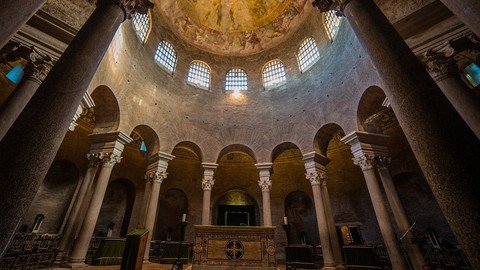
This course takes a look at the architecture of Christianity's earliest and most significant built environments, whether they were houses of worship intended for the use of many or simple markers of the sacred. Rome, Constantinople, Jerusalem, and the Sinai Peninsula in Egypt are the settings for the buildings which this course examines up-close. We see how some of the earliest Christian communities conducted their worship services in the converted private homes or underground catacombs, as at Dura-Europos and Rome respectively. After the fourth century, the Christian community's imperial endorsement prompted a re-evaluation of their religious edifices and its architecture. Whereas the pictorial (and to a more limited extent, the sculptural) artworks of early Christianity had no qualms appropriating Roman and Egyptian forms and symbols, the Greco-Roman temple which had primarily functioned as the residence of the image of the god- usually but not always in the form of a monumental cult statue- was inadequate for the number of people expected to participate in the Christian service. In the ancient world, temples were never designed to accommodate large numbers of people; the cult statues, priests, and a small number of worshippers were the maximum intended capacity, and large ceremonies unfolded along the processional avenues and platforms surrounding the temple itself. Nevertheless, we find Greco-Roman elements adapted and reinterpreted in the context and requirements of the new religion which emerged as its own distinctive architectural tradition which would define a new era in what was once Rome: Western Europe and the Byzantine Empire in the East.
Overview
Section 1: New Forms, New Functions
Lecture 1 The Roman Basilica
Lecture 2 The Circular-Plan Church
Lecture 3 The Lost Churches of Constantinople
Lecture 4 The First Churches in the Holy Land
Lecture 5 Ravenna and the Split of the Roman Empire with Course Vocabulary Review
High school, university, and graduate students will find both a review of key pieces and developments as well as original research and connections which are exclusive to this course.
Homepage
Code:
https://www.udemy.com/course/essentials-of-early-christian-architecture/Recommend Download Link Hight Speed | Please Say Thanks Keep Topic Live
Code:
Rapidgator
https://rapidgator.net/file/df8e9d9af20ddddbf8b503666704aa31/ibeqa.Essentials.Of.Early.Christian.Architecture.rar.html
Uploadgig
https://uploadgig.com/file/download/fa01108AF5ff412e/ibeqa.Essentials.Of.Early.Christian.Architecture.rar
NitroFlare
https://nitroflare.com/view/F78C13C2DFBAFAE/ibeqa.Essentials.Of.Early.Christian.Architecture.rar
