
ByteByteAI - Learn by Doing. Become an AI Engineer Review: Full Breakdown & Strategy Guide
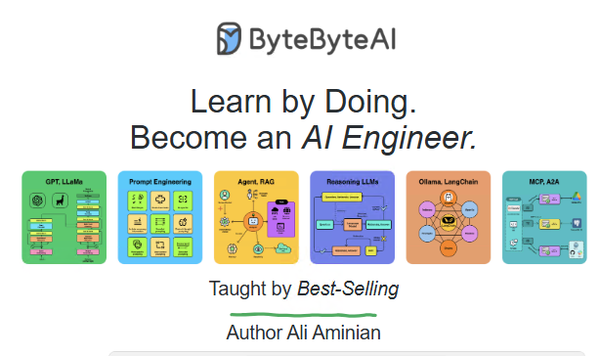
The demand for AI engineers continues to grow, but most learners face the same problem: they understand AI concepts yet struggle to build production-ready systems. ByteByteAI - Learn by Doing. Become an AI Engineer addresses this gap through a project-driven curriculum focused on modern LLMs, RAG systems, AI agents, reasoning models, and multimodal applications.
Why This Program Stands Out
Many AI courses spend weeks explaining theory without showing how real products are built.
ByteByteAI takes the opposite approach.
Instead of stopping at machine learning fundamentals, the program walks students through the technologies powering today's most successful AI products, including chatbots, retrieval systems, research agents, reasoning models, and image generation platforms.
The curriculum follows a practical engineering mindset: understand the concepts, implement them, and deploy working projects.
For professionals seeking job-ready skills, this hands-on approach is often far more valuable than theory-heavy instruction.
What You'll Build
One of the strongest aspects of the course is its emphasis on real-world projects.
Students progressively build:
Each project introduces increasingly advanced concepts while reinforcing practical engineering skills.
Rather than completing isolated coding exercises, learners create systems that resemble products used by actual businesses and startups.
Inside the Curriculum
The training begins with the foundations of large language models.
Students explore:
This foundation helps learners understand not only how AI models behave but also why they behave that way.
The curriculum then expands into adaptation techniques such as fine-tuning, LoRA, PEFT, prompt engineering, and retrieval-augmented generation.
These skills have become increasingly important for businesses seeking cost-effective ways to customize AI solutions without training models from scratch.
Real-World Application Scenario
Imagine a SaaS company receiving hundreds of support requests every day.
Instead of hiring a large support team, an AI engineer could build a retrieval-augmented chatbot trained on internal documentation, product manuals, and support articles.
Using techniques taught throughout the course, the chatbot could retrieve accurate information, generate contextual responses, and reduce support workload significantly.
This type of implementation demonstrates why AI engineering has become such a valuable skill in modern organizations.
The focus is not simply on creating AI models-it is about building systems that solve business problems.
A Look at AI Agents and Reasoning Systems
One particularly relevant section covers agentic workflows and reasoning models.
As AI products evolve, single-prompt interactions are increasingly being replaced by systems capable of planning, tool usage, memory management, and multi-step problem solving.
Students learn concepts such as:
These topics align closely with emerging industry trends where AI systems are expected to perform tasks rather than simply generate text.
Expert Insight
One misconception in the AI learning space is that understanding prompts alone is enough.
The reality is that businesses increasingly need professionals who understand the entire AI stack-from model behavior and retrieval systems to deployment architecture and evaluation.
Courses focused solely on prompting may become outdated quickly, while engineering-focused programs tend to remain valuable because they teach underlying systems and workflows.
ByteByteAI appears designed around this broader perspective, making it relevant for both current and future AI development trends.
Who It's For
This program is particularly suitable for:
Beginners with programming experience can follow the progression, while more experienced developers may benefit from the advanced sections on agents, reasoning systems, and multimodal generation.
Final Thoughts
ByteByteAI's Learn by Doing program delivers a comprehensive roadmap for aspiring AI engineers who want practical, portfolio-worthy experience. By combining LLM foundations, RAG architectures, AI agents, reasoning systems, and multimodal technologies into a project-based learning path, the course bridges the gap between understanding AI and building real AI products.
The future belongs not only to people who can use AI tools, but to those who understand how to design, connect, evaluate, and deploy AI systems that create measurable value.
Official Sales Page:
Many AI courses spend weeks explaining theory without showing how real products are built.
ByteByteAI takes the opposite approach.
Instead of stopping at machine learning fundamentals, the program walks students through the technologies powering today's most successful AI products, including chatbots, retrieval systems, research agents, reasoning models, and image generation platforms.
The curriculum follows a practical engineering mindset: understand the concepts, implement them, and deploy working projects.
For professionals seeking job-ready skills, this hands-on approach is often far more valuable than theory-heavy instruction.
What You'll Build
One of the strongest aspects of the course is its emphasis on real-world projects.
Students progressively build:
- An LLM Playground
- A Customer Support Chatbot using RAG
- An Ask-the-Web AI Agent similar to Perplexity
- A Deep Research Agent with reasoning capabilities
- A Multimodal Generation Agent
- A portfolio-ready capstone project
Each project introduces increasingly advanced concepts while reinforcing practical engineering skills.
Rather than completing isolated coding exercises, learners create systems that resemble products used by actual businesses and startups.
Inside the Curriculum
The training begins with the foundations of large language models.
Students explore:
- Data collection and web crawling
- Data cleaning pipelines
- Tokenization systems
- Transformer architectures
- GPT-style model design
- Text generation strategies
- Supervised fine-tuning
- Reinforcement learning techniques
- Model evaluation methods
This foundation helps learners understand not only how AI models behave but also why they behave that way.
The curriculum then expands into adaptation techniques such as fine-tuning, LoRA, PEFT, prompt engineering, and retrieval-augmented generation.
These skills have become increasingly important for businesses seeking cost-effective ways to customize AI solutions without training models from scratch.
Real-World Application Scenario
Imagine a SaaS company receiving hundreds of support requests every day.
Instead of hiring a large support team, an AI engineer could build a retrieval-augmented chatbot trained on internal documentation, product manuals, and support articles.
Using techniques taught throughout the course, the chatbot could retrieve accurate information, generate contextual responses, and reduce support workload significantly.
This type of implementation demonstrates why AI engineering has become such a valuable skill in modern organizations.
The focus is not simply on creating AI models-it is about building systems that solve business problems.
A Look at AI Agents and Reasoning Systems
One particularly relevant section covers agentic workflows and reasoning models.
As AI products evolve, single-prompt interactions are increasingly being replaced by systems capable of planning, tool usage, memory management, and multi-step problem solving.
Students learn concepts such as:
- Tool calling
- MCP integration
- ReACT frameworks
- Reflexion and ReWOO
- Tree search methodologies
- Multi-agent systems
- Reasoning model architectures
- Inference-time optimization
These topics align closely with emerging industry trends where AI systems are expected to perform tasks rather than simply generate text.
Expert Insight
One misconception in the AI learning space is that understanding prompts alone is enough.
The reality is that businesses increasingly need professionals who understand the entire AI stack-from model behavior and retrieval systems to deployment architecture and evaluation.
Courses focused solely on prompting may become outdated quickly, while engineering-focused programs tend to remain valuable because they teach underlying systems and workflows.
ByteByteAI appears designed around this broader perspective, making it relevant for both current and future AI development trends.
Who It's For
This program is particularly suitable for:
- Software engineers transitioning into AI
- Machine learning practitioners
- Technical founders
- Data professionals
- Product builders
- AI consultants
- Developers creating AI-powered applications
Beginners with programming experience can follow the progression, while more experienced developers may benefit from the advanced sections on agents, reasoning systems, and multimodal generation.
Final Thoughts
ByteByteAI's Learn by Doing program delivers a comprehensive roadmap for aspiring AI engineers who want practical, portfolio-worthy experience. By combining LLM foundations, RAG architectures, AI agents, reasoning systems, and multimodal technologies into a project-based learning path, the course bridges the gap between understanding AI and building real AI products.
The future belongs not only to people who can use AI tools, but to those who understand how to design, connect, evaluate, and deploy AI systems that create measurable value.
Official Sales Page:
Code:
https://bytebyteai.com/c/ai-engineering/Recommend Download Link Hight Speed | Please Say Thanks Keep Topic Live
Rapidgator
f5fal.ByteByteAI__Learn_by_Doing._Become_an_AI_Engineer.part1.rar.html
f5fal.ByteByteAI__Learn_by_Doing._Become_an_AI_Engineer.part2.rar.html
LoadMe
https://www.loadme.cc/file/537f3a8a...rn_by_Doing._Become_an_AI_Engineer.part1.rar/
https://www.loadme.cc/file/70495f7f...rn_by_Doing._Become_an_AI_Engineer.part2.rar/
FreeDL
f5fal.ByteByteAI__Learn_by_Doing._Become_an_AI_Engineer.part1.rar.html
f5fal.ByteByteAI__Learn_by_Doing._Become_an_AI_Engineer.part2.rar.html
Links are Interchangeable - No Password - Single Extraction

