
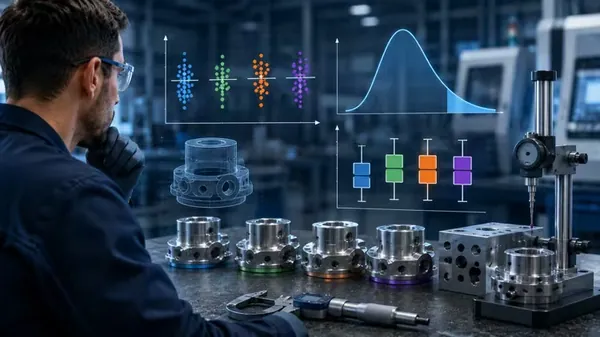
Fundamentals of Analysis of Variance (ANOVA)
Published 6/2026
MP4 | Video: h264, 1920x1080 | Audio: AAC, 44.1 KHz, 2 Ch
Language: English | Duration: 1h 21m | Size: 768.74 MB
Practical ANOVA Using Microsoft Excel for Engineering and Manufacturing Applications
What you'll learn
Explain the purpose of Analysis of Variance (ANOVA) and identify when it is more appropriate than performing multiple t-tests.
State the assumptions required for a valid ANOVA and determine whether those assumptions are reasonably satisfied.
Interpret ANOVA tables, including the F-statistic and p-value, to make statistically sound decisions.
Distinguish between within-group variation and between-group variation, and explain how ANOVA uses both to detect meaningful differences.
Perform one-way and two-way Analysis of Variance (ANOVA) using Microsoft Excel.
Apply ANOVA to common manufacturing, quality, reliability, and industrial engineering problems involving multiple groups.
Communicate ANOVA results clearly and confidently to engineers, managers, customers, and other stakeholders.
Requirements
No prior experience with Analysis of Variance (ANOVA) is required.
A basic understanding of descriptive statistics, including the concepts of mean and standard deviation, is helpful but not required.
Familiarity with Microsoft Excel is recommended, as Excel will be used throughout the course for demonstrations and examples.
An interest in manufacturing, quality engineering, industrial engineering, reliability engineering, or data-driven decision making will help you get the most from the course.
A computer with Microsoft Excel is recommended if you would like to follow along with the hands-on examples.
Description
Every day, engineers and manufacturing professionals compare machines, materials, suppliers, production methods, operators, and process settings. When the data shows differences between groups, an important question arises
Are those differences statistically significant, or are they simply the result of normal process variation?Fundamentals of Analysis of Variance (ANOVA) will teach you how to answer that question with confidence.
Analysis of Variance (ANOVA) is one of the most widely used statistical tools in manufacturing, quality engineering, industrial engineering, reliability engineering, and operations. It provides a systematic method for comparing three or more groups and determining whether observed differences are likely to represent real process changes or random variation.
This course was developed specifically for engineering and manufacturing professionals who want practical analytical skills ... not an academic statistics lecture.
Rather than spending hours deriving formulas, you'll learn the concepts that matter most in the workplace. You'll understand why ANOVA works, when it should be used, the assumptions required for valid results, how to perform the analysis using Microsoft Excel, and most importantly, how to correctly interpret the results to support better engineering decisions.
The course also introduces the F-distribution and F-test as the statistical foundation upon which ANOVA is built before progressing into one-way ANOVA and practical applications.
Throughout the course, you'll work through realistic engineering examples while learning how to
- Understand the purpose and logic behind Analysis of Variance (ANOVA)
- Determine when ANOVA is the appropriate statistical tool
- Interpret F-statistics and p-values with confidence
- Verify the assumptions required for a valid ANOVA
- Perform one-way ANOVA using Microsoft Excel
- Compare multiple groups without relying on multiple t-tests
- Draw meaningful conclusions from engineering and manufacturing data
- Communicate statistical findings clearly to managers, customers, and technical teams
Whether you're evaluating suppliers, comparing manufacturing processes, validating process improvements, analyzing product performance, or conducting engineering experiments, ANOVA is an essential tool that belongs in every engineer's analytical toolbox.
Why enroll in this course?
When you enroll, you'll receive
- Lifetime access to the course
- able Excel templates and supporting resources
- Practice exercises to reinforce your learning
- Direct access to the instructors through Udemy's Q&A feature
- Future course updates at no additional cost
- A Udemy Certificate of Completion
Whether you're a manufacturing engineer, quality engineer, industrial engineer, reliability engineer, laboratory professional, continuous improvement specialist, or technical manager, this course will help you strengthen your statistical decision-making skills and become more confident when analyzing data.
If you're ready to make better engineering decisions using one of the most valuable statistical tools available, I look forward to seeing you inFundamentals of Analysis of Variance (ANOVA).
Who this course is for
Manufacturing engineers who want to make better data-driven decisions using statistical analysis.
Quality engineers and quality technicians responsible for analyzing process, product, or supplier performance.
Industrial engineers seeking practical tools for comparing multiple processes, machines, operators, or materials.
Reliability engineers who need to determine whether differences between groups are statistically significant.
Continuous improvement professionals using Lean Six Sigma or other improvement methodologies.
Manufacturing supervisors, managers, and technical leaders who regularly review production and quality data.
Engineering and technical professionals who understand basic statistics and want to learn when and how to use Analysis of Variance (ANOVA).
Students preparing for careers in manufacturing, quality, industrial engineering, or operations who want a practical introduction to ANOVA.
Recommend Download Link Hight Speed | Please Say Thanks Keep Topic Live
Rapidgator
kridy.Fundamentals.of.Analysis.of.Variance.ANOVA.rar.html
AlfaFile
kridy.Fundamentals.of.Analysis.of.Variance.ANOVA.rar
No Password - Links are Interchangeable

