
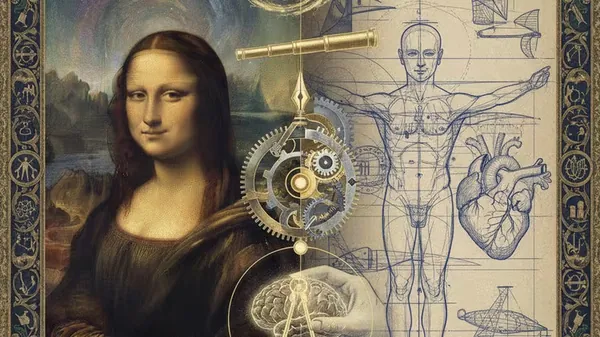
Leonardo Da Vinci Art, Science and Universal Vision
Published 7/2026
MP4 | Video: h264, 1920x1080 | Audio: AAC, 44.1 KHz, 2 Ch
Language: English | Duration: 41m | Size: 366.31 MB
Leonardo da Vinci, Renaissance art, scientific observation, engineering, and universal knowledge
What you'll learn
Build foundational knowledge of Leonardo's context, key ideas, and universal Renaissance vision.
Identify the major phases of Leonardo's life from Vinci and Florence to Milan and France.
Explain how Leonardo connected painting, anatomy, mechanics, optics, water, and flight.
Analyze key artworks including The Last Supper, Mona Lisa, and The Virgin of the Rocks.
Describe the role of notebooks, codices, observation, and experiment in Leonardo's method.
Situate Leonardo's legacy in modern science, design, popular culture, and interdisciplinary thought.
Requirements
No specialized background in art history, Renaissance studies, or the history of science is required. This is an L2 course, so it is designed for learners who want a focused, structured introduction to Leonardo da Vinci as an artist, scientist, engineer, and universal thinker. A basic familiarity with European history or Renaissance culture may be helpful, but the course introduces the essential context directly. Learners should be willing to engage with artworks, historical interpretation, scientific ideas, and intellectual biography in a serious but accessible way.
Description
[This course contains the use of artificial intelligence]
Welcome to my new course! This course examinesLeonardo da Vinci as one of the central figures of theRenaissance, not only as a painter, but as an artist, engineer, anatomist, inventor, and theorist of knowledge. Its purpose is to give learners a structured L2 foundation for understanding Leonardo's historical context, his major works, his scientific curiosity, and his enduring universal vision.
This course contains the use of artificial intelligence: it is created with the help of AI according to a protocol that I have elaborated during these few years. Created through my hybrid approach, this course merges the synthetic capabilities of AI with strict human curation, ensuring all content is deeply rooted in a hand-picked reference bibliography.
The course begins with Leonardo's life and times, from his birth in Vinci and his apprenticeship in Florence to his Milanese maturity and final years in France. This biographical framework is not treated as anecdote, but as the necessary historical ground for understanding how courts, workshops, patrons, rivalries, and humanist culture shaped his intellectual development.
A central part of the course is devoted to Leonardo'sart. Through works such as The Virgin of the Rocks, The Last Supper, and Mona Lisa, the course explains his use of sfumato, chiaroscuro, perspective, anatomical observation, psychological expression, and atmospheric landscape. Painting appears here not as decoration, but as a disciplined inquiry into visible reality.
The course then turns to Leonardo'sscience, including anatomy, mechanics, optics, hydraulics, flight, automation, and engineering. Hisnotebooks and codices reveal a method based on observation, drawing, comparison, and verification. This approach allows the course to connect artistic practice with early scientific reasoning, showing why Leonardo remains a model ofinterdisciplinary knowledge.
By the end, learners will be prepared to situate Leonardo within Renaissance culture, explain the unity of his artistic and scientific method, and continue through the DOC catalog toward deeper mastery of primary works, critical scholarship, and specialized study.
Who this course is for
This course is for learners interested in Leonardo da Vinci, Renaissance art, the history of science, and the relationship between creativity and knowledge. It is suitable for students, teachers, artists, designers, humanities learners, and intellectually curious adults who want more than a superficial overview. The course is especially valuable for those who want to understand Leonardo as a unified thinker: not simply the painter of the Mona Lisa, but a figure who connected painting, anatomy, engineering, mechanics, optics, water, flight, and philosophy into a single vision of nature.
Homepage
Recommend Download Link Hight Speed | Please Say Thanks Keep Topic Live
Rapidgator
fpkuj.Leonardo.Da.Vinci.Art.Science.and.Universal.Vision.rar.html
AlfaFile
fpkuj.Leonardo.Da.Vinci.Art.Science.and.Universal.Vision.rar
No Password - Links are Interchangeable

